


 Current
location:
Current
location:Introduction: The Value Equation in Laboratory Instrumentation
Laboratory instrumentation purchasing decisions are rarely based on technical specifications alone. The total cost of ownership, including acquisition price, maintenance expenses, consumables, training, and downtime, determines the true economic value of any analytical instrument. For full-wavelength microplate readers, which serve as workhorse instruments in many laboratories, the cost-performance ratio is particularly important because these devices are often purchased in multiples to support high-throughput operations.
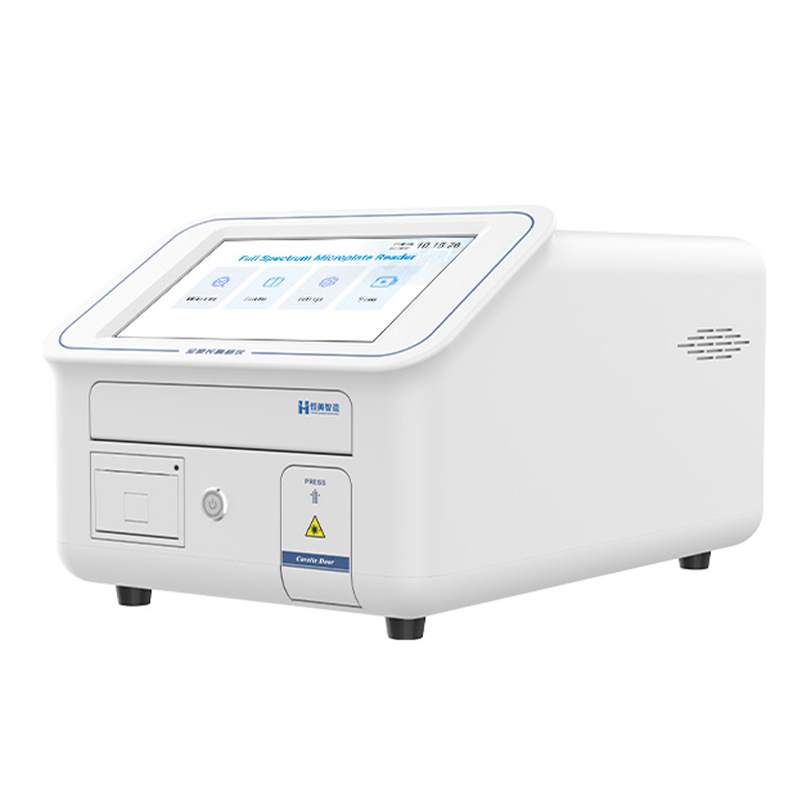
This review provides an objective, specification-based comparison of the HM-96Q full-wavelength microplate reader from HM Instruments against established international competitors. The analysis respects the technical achievements of leading Western manufacturers while demonstrating that the HM-96Q achieves equivalent performance at a substantially lower total cost of ownership.
Competitive Landscape and Pricing Context
The full-wavelength microplate reader market is dominated by several established manufacturers whose products command premium prices based on brand reputation, extensive application literature, and global service networks. Representative pricing for entry-level to mid-range full-wavelength microplate readers from these manufacturers typically falls in the $25,000-$60,000 range, depending on configuration and included software options.
The HM-96Q, positioned at approximately $12,143, represents a significant departure from this pricing structure. To evaluate whether this lower price reflects compromised performance or genuine value creation, we compare the HM-96Q against representative models from three leading competitors across all critical performance dimensions.
Optical Performance Comparison
| Specification | HM-96Q (HM Instruments) | Thermo Multiskan SkyHigh | Molecular Devices SpectraMax iD3 | BioTek Epoch 2 |
|---|---|---|---|---|
| Wavelength Range | 190-1100 nm | 200-1000 nm | 230-1000 nm | 200-999 nm |
| Wavelength Accuracy | ±2 nm | ±2.0 nm | ±2.0 nm | ±2.0 nm |
| Wavelength Repeatability | ≤0.2 nm | ≤0.5 nm | ≤0.2 nm | ≤0.2 nm |
| Optical Bandwidth | <2.5 nm | 2.5 nm | 2.0 nm | 2.0 nm |
| Stray Light | ≤0.05% @ 220 nm | ≤0.05% @ 220 nm | ≤0.05% @ 230 nm | Not specified |
| Absorbance Range | 0-4.0 Abs | 0-4.0 Abs | 0-4.0 Abs | 0-4.0 Abs |
| Absorbance Linearity | R²≥0.999 (0-3.0 Abs) | R²≥0.999 | R²≥0.999 | R²≥0.999 |
The optical performance comparison reveals that the HM-96Q achieves equivalence with international competitors across all fundamental specifications. Notably, the HM-96Q's wavelength range (190-1100 nm) actually exceeds that of the compared models, extending further into both the deep UV and near-IR regions. This broader range may provide advantages for specialized applications involving compounds with absorption features outside the typical 200-1000 nm window.
Measurement Speed and Precision
| Parameter | HM-96Q | Typical International Model |
|---|---|---|
| 96-Well Read Time (Fast Mode) | <8 seconds | <10 seconds |
| 96-Well Read Time (Precision Mode) | <28 seconds | <30 seconds |
| Repeatability (Precision Mode) | CV<0.5% or SD<0.003 | CV<0.5% |
| Repeatability (Fast Mode) | CV<1.0% | CV<1.0% |
Measurement speed and precision are essentially identical across all compared instruments. The HM-96Q's fast mode under 8 seconds per plate matches or exceeds the throughput of competitive instruments, while the precision mode delivers the CV<0.5% repeatability required for quantitative applications. For laboratories processing large numbers of plates daily, this performance parity means that workflow capacity is not compromised by selecting the lower-priced instrument.
Software and User Experience
Software has become a critical differentiator in modern laboratory instruments. International competitors typically offer mature software platforms with extensive application libraries and integration capabilities. However, these software packages often carry additional licensing costs and may require dedicated training.
The HM-96Q's Android 10 operating system with a 10-inch color touchscreen represents a different software philosophy. The familiar Android interface reduces training time for operators who have used smartphones or tablets. Key software features include:
One-click template calling for routine assays
Customizable workflow definitions
Concentration gradient calibration with automatic curve fitting
Chinese-English bilingual interface
Real-time data display and basic analysis
USB export to Excel and PDF formats
While the HM-96Q software may not yet offer the depth of application-specific protocols found in platforms like SoftMax Pro, it covers the essential functions required for standard microplate assays. For laboratories without complex data analysis requirements, the streamlined interface may actually represent an advantage in terms of simplicity and reduced training burden.
Compliance and Data Integrity
Regulated laboratories in pharmaceutical, clinical, and food safety sectors require instruments that support compliance with quality management standards. The HM-96Q addresses these requirements through:
Three-level user permission management preventing unauthorized method modifications
Complete audit trails recording all user actions with timestamps
Automatic self-diagnostic programs generating instrument qualification records
Non-modifiable PDF data export supporting electronic record integrity
These features correspond to the compliance capabilities offered by international competitors, though the depth of validation documentation and regulatory support services may differ. For laboratories with established internal validation protocols, the HM-96Q provides the necessary technical foundation for compliant operation.
Total Cost of Ownership Analysis
Beyond acquisition price, the total cost of ownership includes maintenance, consumables, and operational expenses over the instrument's lifetime. The HM-96Q's pulsed xenon lamp with >109 flash lifetime minimizes lamp replacement costs. The Android-based software platform receives remote updates via Wi-Fi, reducing service visit requirements.
For a typical 7-year ownership period, the total cost advantage of the HM-96Q over international competitors can exceed $20,000-$40,000 per instrument, depending on service contract pricing and consumable costs. Laboratories deploying multiple instruments realize proportionally larger savings.
Application-Specific Value Assessment
Pharmaceutical QC
For regulated pharmaceutical QC laboratories, the HM-96Q's compliance features and optical performance support standard assays including ELISA, protein quantification, and cell viability. The value proposition is strongest for laboratories with internal validation capabilities who do not require vendor-managed qualification services.
Academic Research
Research laboratories operating on grant funding benefit most directly from the HM-96Q's lower acquisition cost. The combination of endpoint, kinetic, and spectral scanning modes within a single affordable platform enables diverse research applications without compromising core performance.
Clinical Diagnostics
High-volume diagnostic laboratories prioritize measurement speed and reliability. The HM-96Q's fast mode under 8 seconds per plate and CV<0.5% precision mode meet these requirements while reducing capital expenditure for instrument procurement.
Conclusion
International manufacturers such as Thermo Fisher, Molecular Devices, and BioTek have established their market positions through decades of reliable performance and comprehensive support infrastructure. Their products remain excellent choices for laboratories requiring extensive application libraries, vendor-managed validation, or integration with existing software ecosystems.
However, the HM-96Q from HM Instruments demonstrates that the performance gap between premium international brands and well-engineered Chinese alternatives has narrowed to the point of practical irrelevance for standard microplate applications. With equivalent optical specifications, matching measurement speed and precision, modern Android-based software, and comprehensive compliance features, the HM-96Q delivers the analytical capabilities that laboratories actually need.
For organizations prioritizing analytical performance per dollar invested, the HM-96Q represents a rational choice that frees budget for other laboratory investments without compromising measurement quality. As Chinese instrument manufacturers continue to advance their technology and service capabilities, the value proposition will only strengthen.
Article address:https://www.molecularbio.cn/news/hm-96q-cost-performance-review-microplate-reader.html