


 Current
location:
Current
location:Executive Summary
Full-wavelength microplate readers have evolved from simple absorbance measurement tools into versatile analytical platforms that support quantitative analysis across multiple industries. By combining UV-Vis spectrophotometry with high-throughput sample handling, these instruments enable rapid, precise, and cost-effective testing for applications ranging from drug discovery to environmental monitoring.
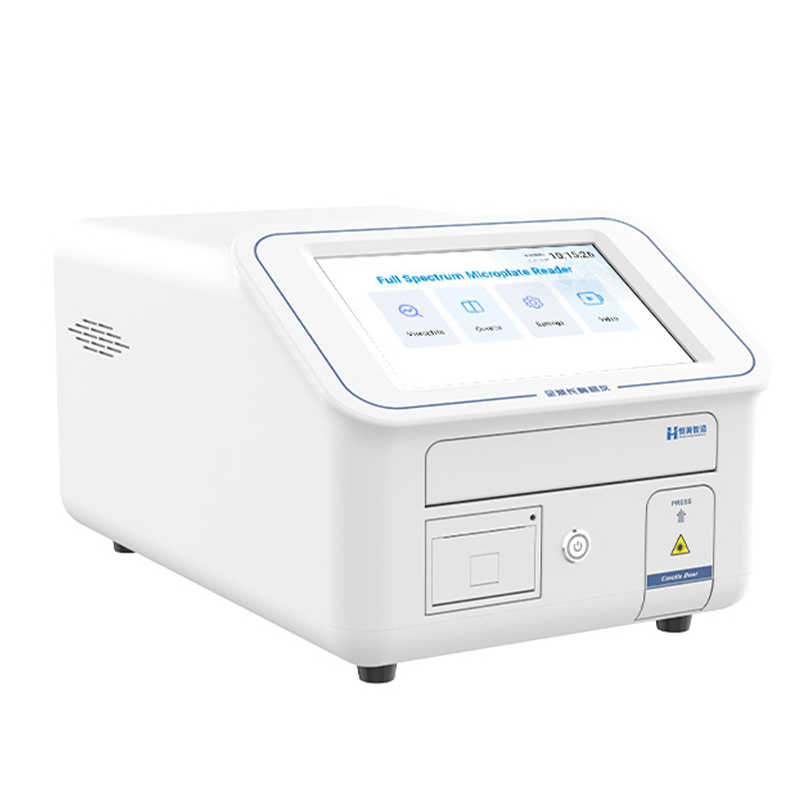
This white paper examines how full-wavelength microplate reader technology is applied in four critical sectors: pharmaceutical and biotechnology, clinical diagnostics, food safety and agriculture, and environmental monitoring. Drawing on the technical capabilities of the HM-96Q from HM Instruments, we illustrate how modern instruments address industry-specific challenges and contribute to improved outcomes in research, quality control, and regulatory compliance.
1. Pharmaceutical and Biotechnology Applications
1.1 High-Throughput Screening in Drug Discovery
The pharmaceutical industry relies heavily on microplate-based assays during the early stages of drug development. High-throughput screening (HTS) campaigns can evaluate thousands of compounds against biological targets within days, but this throughput demands instrumentation that combines speed with measurement confidence.
Full-wavelength microplate readers like the HM-96Q address this need through fast-mode measurement speeds under 8 seconds per 96-well plate and compatibility with diverse assay chemistries. The 190-1100 nm wavelength range supports colorimetric assays (e.g., MTT for cell viability), fluorescence-based screens, and label-free detection methods that exploit intrinsic UV absorbance of drug candidates.
The dual-beam reference optical path design is particularly valuable in HTS environments where laboratories operate continuously and environmental conditions may fluctuate. Real-time compensation for source drift ensures that data collected across extended screening runs remains internally consistent, reducing false positives and false negatives in hit identification.
1.2 Pharmacokinetic and Toxicity Studies
Once lead compounds are identified, their absorption, distribution, metabolism, and excretion (ADME) profiles must be characterized. Microplate-based methods for protein binding assays, metabolic stability screening, and cytotoxicity evaluation are standard tools in pharmaceutical development pipelines.
The HM-96Q's kinetic detection mode enables time-course monitoring of enzyme reactions and cell-based toxicity assays, while its temperature-controlled incubation (RT+4°C to 45°C, ±0.5°C uniformity) ensures that reactions proceed under physiologically relevant conditions. The ability to perform spectral scanning allows researchers to identify optimal detection wavelengths for new assay formats and verify compound purity before biological testing.
1.3 Biologics Quality Control
The growing market for biologic therapeutics, including monoclonal antibodies and recombinant proteins, has created demand for analytical instruments capable of supporting QC release testing. Protein concentration determination by A280 measurement, endotoxin detection by LAL assays, and potency measurement by cell-based bioassays all rely on microplate reader technology.
GLP/GMP compliance features in the HM-96Q, including three-level user permissions, complete audit trails, and automatic diagnostic programs, directly support the documentation requirements of biologics manufacturing. Data export in PDF format provides tamper-evident records suitable for regulatory submission.
2. Clinical Diagnostics
2.1 ELISA-Based Diagnostic Testing
Enzyme-linked immunosorbent assays (ELISA) remain one of the most widely used diagnostic methodologies in clinical laboratories. Infectious disease serology, hormone measurement, tumor marker detection, and autoimmune antibody screening all depend on microplate-based ELISA formats.
The HM-96Q's endpoint detection mode at 450 nm (with reference wavelengths at 620-650 nm) is optimized for the TMB substrate chemistry used in the majority of clinical ELISA kits. The precision mode repeatability of CV<0.5% ensures that diagnostic results meet clinical accuracy requirements, while the fast mode supports high-volume testing during disease outbreak responses.
2.2 Protein and Nucleic Acid Biomarker Quantification
Modern clinical diagnostics increasingly relies on protein biomarkers and circulating nucleic acids for disease detection and monitoring. Microplate-based methods for C-reactive protein, prostate-specific antigen, and cell-free DNA quantification require instruments with broad wavelength coverage and high sensitivity.
The 190-1100 nm range of the HM-96Q supports direct UV quantification of nucleic acids at 260 nm and protein at 280 nm, as well as colorimetric methods such as BCA and Bradford for total protein measurement. Spectral scanning capability enables verification of nucleic acid purity through 260/280 and 260/230 ratio analysis.
3. Food Safety and Agriculture
3.1 Allergen and Toxin Detection
Food safety laboratories face growing pressure to detect allergens, mycotoxins, and bacterial toxins at increasingly lower concentrations. Microplate-based ELISA methods for peanut, gluten, milk, and egg allergens are standard tools in food manufacturing QC.
The HM-96Q's broad wavelength range supports diverse chromogenic substrates used in food safety ELISA kits, while its Android-based software enables rapid template loading for routine testing panels. The ability to export data directly to Excel facilitates integration with laboratory information management systems used in food manufacturing environments.
3.2 Pesticide Residue Screening
Colorimetric enzyme inhibition assays for organophosphate and carbamate pesticide residues represent a cost-effective alternative to chromatographic methods for screening large numbers of samples. These assays measure the inhibition of acetylcholinesterase activity, with absorbance changes detected at 412 nm.
The HM-96Q's wavelength accuracy of ±2 nm and repeatability of ≤0.2 nm ensure that measurements at the critical 412 nm wavelength are reliable and reproducible. The fast measurement mode supports the high sample throughput required during harvest seasons when residue testing volumes peak.
3.3 Agricultural Pathogen Detection
Plant pathogen detection in seeds, soil, and plant tissue increasingly uses microplate-based immunoassays and nucleic acid hybridization methods. The ability to perform spectral scanning supports the development and validation of new pathogen detection assays by enabling characterization of optimal detection wavelengths for different chromogenic or fluorogenic reporter systems.
4. Environmental Monitoring
4.1 Water Quality Analysis
Environmental laboratories routinely analyze water samples for nutrients (nitrate, phosphate, ammonia), heavy metals, and organic pollutants. Many standardized colorimetric methods, such as those specified by EPA and ISO protocols, are readily adapted to microplate format.
The HM-96Q's wavelength range covers the visible spectrum where most colorimetric environmental assays are detected (typically 400-700 nm) while extending into the UV for direct measurement of parameters such as UV254 absorbance, an indicator of organic matter content in drinking water. Temperature-controlled incubation supports enzyme-based assays requiring reaction at specific temperatures.
4.2 Soil Contaminant Screening
Soil testing for heavy metals, petroleum hydrocarbons, and pesticide residues often employs microplate-based extraction and detection methods. The ability to run both endpoint and kinetic assays on a single platform allows laboratories to adapt methods from different regulatory frameworks without maintaining multiple dedicated instruments.
Cross-Cutting Technical Advantages
Several features of the HM-96Q provide value across all four application sectors:
Multi-mode detection: Endpoint, kinetic, and spectral scanning capabilities eliminate the need for multiple instruments in laboratories with diverse assay portfolios.
Dual compatibility: Support for both microplates and cuvettes allows method development and validation in cuvette format before scaling to high-throughput microplate workflows.
Regulatory compliance: GLP/GMP support features, including audit trails and user management, meet documentation requirements across pharmaceutical, clinical, food safety, and environmental testing sectors.
Connectivity and data management: USB and Wi-Fi connectivity, combined with Excel and PDF export, facilitate integration with modern laboratory information systems.
Language flexibility: Chinese-English bilingual operation supports multinational organizations and laboratories in diverse geographic regions.
Conclusion
Full-wavelength microplate readers have become indispensable analytical tools across pharmaceutical, clinical, food safety, and environmental sectors. The technology's combination of spectrophotometric precision, high-throughput handling, and software flexibility enables applications that would be impractical with single-purpose instruments.
The HM-96Q from HM Instruments exemplifies how modern microplate reader design can address the cross-sector requirements of speed, accuracy, compliance, and versatility. As assay methodologies continue to evolve and regulatory expectations increase, instruments that combine robust optical performance with intelligent software and connectivity features will remain at the center of laboratory operations worldwide.
Article address:https://www.molecularbio.cn/news/full-wavelength-microplate-reader-industry-application-white-paper.html