


 Current
location:
An authenticity result that cannot be defended is worse than no result: it consumes enforcement resource, exposes the authority to challenge, and leaves the product on the market. Most failures are not analytical. They are sampling and documentation failures that surface months later in a hearing.
This article sets out the practices that make a species-identification result stand, written for inspectors and food control laboratories by the engineering team at HENG MEI Intelligent Manufacturing.
Chain of custody starts at the shelf
The sample's legal weight depends on being able to show it came from that product, at that place, at that time. Four items are non-negotiable.
- Photograph the product in situ with its label, batch code and shelf position visible.
- Record the batch or lot code from the pack, not from the invoice; they differ more often than expected.
- Seal and sign the sample container at the point of collection, with a unique sample number.
- Record temperature and time of collection and of receipt at the laboratory; a sample that thawed in transit invites a challenge about degradation.
Sample size and homogenisation
Processed meat is heterogeneous by design. Emulsions separate, fat and lean distribute unevenly, and a small portion may not contain the species that a larger portion does. Two practices reduce that risk.
Take enough material. A retail pack is preferable to a subsample; where only part can be taken, take a portion that includes both surface and interior.
Homogenise the whole laboratory sample before drawing the test portion. Grinding and mixing in a laboratory mill, with cleaning between samples, gives a test portion that represents the sample. A core taken from one end does not.

Controls that answer the challenge before it is made
| Control | What it demonstrates | Consequence if omitted |
|---|---|---|
| Positive control (target species DNA) | The assay worked and can detect the target | A negative cannot be distinguished from a failed run |
| No-template control | No contamination entered the reaction | Positive results open to challenge |
| Extraction blank | Extraction reagents were clean | Cross-contamination between samples cannot be excluded |
| Internal amplification control in each sample | The matrix did not inhibit amplification | False negatives reported as absence |
| Duplicate test portion | The result is repeatable within the sample | The heterogeneity defence remains open |
The internal amplification control is the one most often dropped under time pressure and the one most damaging to a case, because inhibition by meat matrices is common and silent.
Reporting language that survives review
The wording of a report determines what can be concluded from it. Three formulations are defensible and one is not.
- Defensible: "DNA of Sus scrofa (domestic pig) was detected in the sample."
- Defensible: "The sample did not contain detectable DNA of the species on the tested panel, at the validated limit of detection for this matrix."
- Defensible with quantification: "Pork DNA was estimated at X% (w/w) by quantitative real-time PCR against certified reference materials."
- Not defensible: "The product contains 5% pork" — when the method was qualitative.
The negative formulation matters as much as the positive. A panel that tested three species cannot support the statement "no undeclared species present"; it can only support "none of the tested species detected".
Confirmation strategy for contested cases
Where a result will be contested, plan confirmation before the case is filed. Options include a second assay targeting a different gene region, sequencing of the amplicon to establish identity at species level, or testing at a second laboratory. The choice should be documented in the sampling plan rather than decided after a challenge arrives.
Laboratories should also establish their own limits of detection per product type. A detection limit validated in raw mince does not transfer to a retorted canned product, where DNA is fragmented and inhibitors concentrate.
Instrument and workflow notes
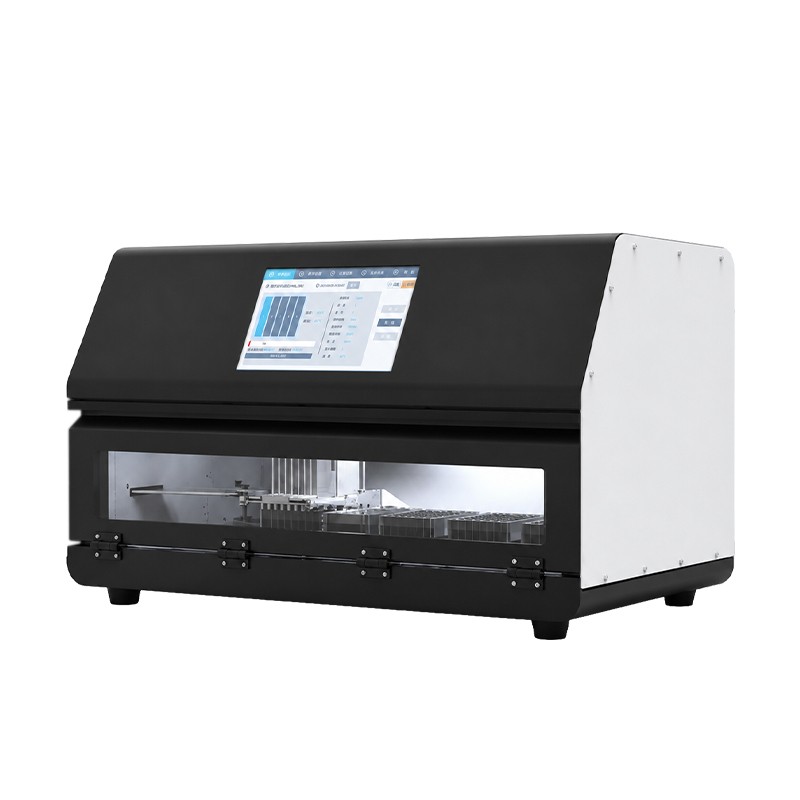
The instrument requirements for this work — 16 wells, two fluorescence channels so the internal control runs in the same tube as the target, and temperature uniformity that keeps low-level replicates comparable — are set out in our meat species identification guide. The laboratory workflow around the instrument, including homogenisation and extraction validation, matters more than the model number.
HENG MEI Intelligent Manufacturing supplies real-time PCR instruments in 8, 16 and 32-well formats for food control laboratories, with assay panels selected to the jurisdiction's target species list. To plan a sampling and testing programme, tell our sales contact the product categories, the species panel, the samples per month and whether results must support enforcement action.
Contact: Arthur, Sales Contact, Arthur@hmdzkj.cn, +86 18353666151 (Tel / WhatsApp / WeChat).
Article address:https://www.molecularbio.cn/news/meat-authenticity-sampling-enforcement.html