

 Current
location:
Library preparation protocols specify an input mass, usually in nanograms. The protocol assumes that mass is accurate. When it is not, the consequences are not subtle: too little input reduces library complexity and coverage, too much produces adapter-dimers and over-sequenced libraries, and both waste a run that may have taken weeks to organise.
This article explains why the quantification method, not just the number, determines whether the input is right. It is written by the engineering team at HENG MEI Intelligent Manufacturing.
Why A260 misleads at the input stage
Absorbance at 260 nm measures all UV-absorbing material in the sample. In a clean, high-concentration DNA preparation, that is mostly DNA and the estimate is acceptable. In the samples that most often precede library preparation — small eluates from low-input extractions, ancient or degraded material, samples with residual guanidine or phenol — the same measurement includes contaminants and overstates the DNA.
The practical failure mode is a library prepared at "10 ng" that behaves like 2 ng: low complexity, high duplication, uneven coverage. The protocol was not wrong; the input estimate was.
Fluorometric quantification avoids this because the dye binds double-stranded DNA specifically. Contaminants that absorb at 260 nm do not fluoresce, so the signal tracks the target rather than total absorbance.
The low-input range is where the difference is decisive
| Sample situation | A260 estimate | Fluorometric dsDNA |
|---|---|---|
| Clean gDNA at 50 ng/µL | Acceptable | Accurate |
| Clean gDNA at 5 ng/µL | Marginal | Accurate |
| Eluate at 0.5 ng/µL | Unreliable, usually high | Within assay range |
| Sample with residual phenol or guanidine | Overestimated | Unaffected by these contaminants |
| Sample containing RNA | Counts RNA as DNA | dsDNA assay ignores RNA |
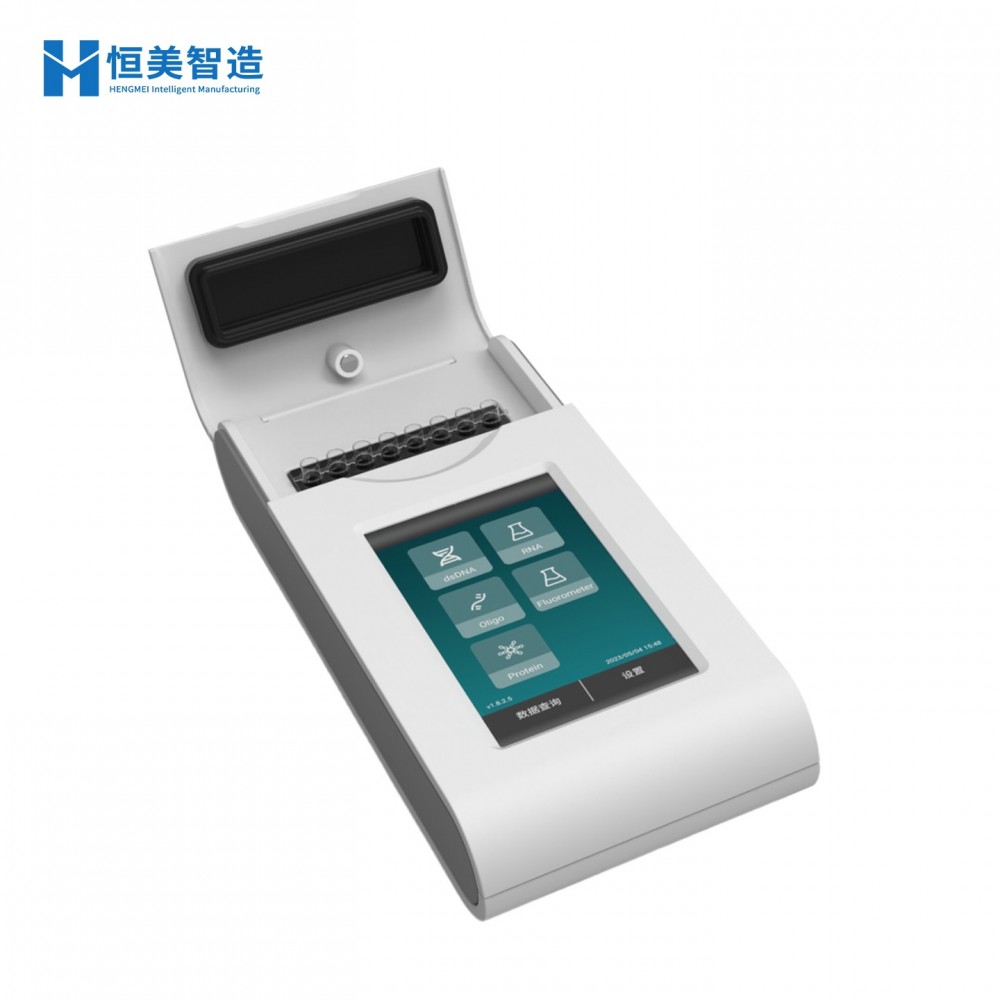
An eight-sample fluorometer with a dsDNA sensitivity of 0.01 ng/µL covers that whole table. The instrument described in our quantification guide reads 1–20 µL samples in under five seconds each, which fits the batch of eight eluates that a typical extraction plate produces.
What wrong input actually does
| Problem | Cause | Symptom in the data |
|---|---|---|
| Low library complexity | Input underestimated | High duplication, uneven coverage, poor variant detection |
| Adapter dimers | Input overestimated | Short insert peak, wasted sequencing reads |
| Failed library | Inhibitors carried through | Low yield despite adequate DNA by A260 |
| Skewed coverage | RNA contamination in a DNA prep | Unexpected signal in transcribed regions |
All four present as "library prep problem" and are usually investigated at the wrong end of the workflow. A quantification check at the start is cheaper than troubleshooting at the end.
Practical routine for a sequencing laboratory
- Quantify by fluorescence, not absorbance, for anything destined for library preparation.
- Match the assay to the expected range: high-sensitivity for sub-nanogram samples, broad-range for routine.
- Run the kit standards every time, and reject runs where the standard curve is out of specification.
- Record the assay name with the value. A concentration without its method cannot be compared with anything.
- Check purity separately if it matters — a spectrophotometric ratio or a gel — because fluorescence does not report contaminants, only the target.
When a single-channel instrument is enough, and when it is not
A single-channel fluorometer with a blue excitation and green emission pair covers dsDNA assays, which is the dominant need in a sequencing laboratory. It also covers protein assays in the same channel configuration on some models.
What it does not cover is RNA quantification, apart from the microRNA option on specific models. Laboratories preparing RNA libraries need a second dye chemistry — and therefore a dual-excitation instrument — or a separate workflow. Buyers should confirm the exact assay menu of the model before purchase rather than assume that "fluorometer" implies all nucleic acids.
How HENG MEI supports sequencing workflows
HENG MEI Intelligent Manufacturing supplies the YP-QT8 eight-sample fluorometer with 1–20 µL sample volume, ≤5 s per sample, SiPMT detection and dsDNA sensitivity to 0.01 ng/µL, alongside single-sample and 96-sample models in the same family for higher throughput, and micro-volume spectrophotometers where absorbance measurement is still required.
To match a model to a sequencing workflow, tell our sales contact the sample types, the concentration range, whether RNA is quantified in-house, and the samples per day. Those four facts decide between single-channel and dual-channel, and between eight and ninety-six positions.
Contact: Kyra, Sales Contact, Kyra@hmdzkj.cn, +86 13792642016 (Tel / WhatsApp / WeChat).
Article address:https://www.molecularbio.cn/news/quantifying-dna-before-library-preparation.html