


 Current
location:
Most clean areas that fail an environmental audit do not fail because the sampler was wrong. They fail because the monitoring round was not reproducible: different points sampled on different days, plates carried through a corridor without lids, volumes estimated by watching a clock, results written on a sheet that later cannot be matched to a location.
This article describes a routine that works with a basic impactor in a clean area where the monitoring plan is stable. It is written by the engineering team at HENG MEI Intelligent Manufacturing for pharmacy, food and cosmetics operations running weekly or per-batch monitoring.
Define the points on a drawing
Before the first sample, mark the monitoring points on the room layout. A workable pattern for a production room uses four categories.
- Worst-case location — where airflow is least clean: near a door, at the return air grille, in the lee of equipment.
- Product exposure location — directly above an open product or the filling zone.
- Operator location — where staff stand, since people are the dominant particle source.
- Background location — a fixed reference point for trend comparison.
Each point gets an identifier that appears on the plate, the record and the layout. Without that identifier the result is a number without a location, and the trend analysis that makes monitoring useful becomes impossible.

Sampling sequence and the disturbance problem
Sampling disturbs the room. A person entering, a sampler placed in a unidirectional airstream, a lid removed from a plate — each changes the local particle profile for a short period. Three rules keep the disturbance from contaminating the result.
- Sample in a fixed order, from cleanest location to least clean. Reversing the order carries contamination from the dirty end of the room to the clean end.
- Set the sampler, then step back. The operator should not stand in the sampling path during the run.
- Disinfect the sampler between points. The exterior, the head and the base. A sampler used at four points without wiping is a transport device.
Volume and timing without a programmable instrument
At 100 L/min, volume is time: 500 L is five minutes, 1,000 L is ten. A basic sampler with a user-set period handles this well, provided the operator uses a timer rather than an estimate. The practical discipline is one point, one timer, one recorded volume — not four points sampled while watching a wall clock.
Where the plan requires different volumes for different grades, write the volume and the corresponding duration on the monitoring sheet in advance. Operators should not be calculating during a sampling round.
Plate handling from bench to incubator
| Step | Requirement | Common error |
|---|---|---|
| Plate preparation | Defined medium, defined fill volume, level surface | Uneven agar causing impaction at one side |
| Transport to the room | Sealed, in a carrier | Lid removed in the corridor |
| Exposure | Head positioned per procedure; lid off only during the run | Plate left open while setting up the next point |
| After sampling | Lid replaced, plate labelled with point and volume | Labelling at the incubator, after plates are mixed up |
| Incubation | Stated temperature and duration per medium | Bacterial and fungal plates incubated together |
The labelling step is where most monitoring records break. Two operators sampling twenty points and labelling afterwards will eventually transpose two plates. Labelling at the point, with the point identifier already printed on the label, removes the possibility.
Reading and reporting
Count colonies on a colony counter, divide by the litres sampled, multiply by 1,000. Report the value with the point, the volume, the medium and the incubation conditions. A result reported as "12 CFU" without a volume cannot be compared with anything.
Plates that are overcrowded — above roughly 200 colonies — should be reported as too numerous to count rather than estimated. An estimate presented as a count is the kind of number that survives until someone asks how it was obtained.
Handling an excursion
An out-of-limit result should trigger a defined sequence: notify production, review the room's recent history, check whether the result is a single point or a pattern, and re-sample before changing the cleaning regime. A single excursion at one point is often an event; the same point failing twice is a condition, and conditions require a change to cleaning, airflow or equipment.
Trend review matters more than any single result. A room that has drifted from 5 to 20 CFU/m³ over six months is telling you something — a filter approaching the end of its life, a change in cleaning chemistry, a new piece of equipment disturbing airflow — long before it breaches a limit.
Instruments for this routine
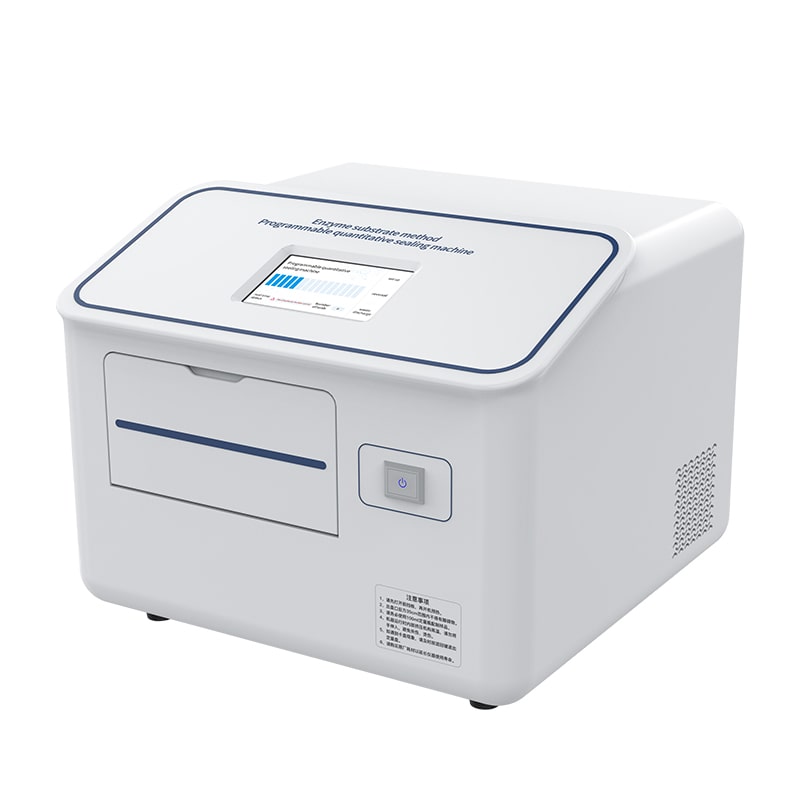
The basic impactor used here, its 100 L/min flow and 0.38 m/s orifice velocity, is described in our sampler selection guide. Where the routine needs graded volumes per point and printed records at the sampling location, the programmable sampler covers that requirement.
HENG MEI Intelligent Manufacturing supplies both formats with the same 90 mm plate standard, so a monitoring routine can be documented once and used across instruments. To adapt this routine, tell our sales contact the area grades, the number of points, the volumes in your procedure and the incubation conditions you use.
Contact: Arthur, Sales Contact, Arthur@hmdzkj.cn, +86 18353666151 (Tel / WhatsApp / WeChat).
Article address:https://www.molecularbio.cn/news/routine-viable-air-monitoring-clean-areas.html