


 Current
location:
Choose an animal disease diagnostic instrument by the test method and sample workflow first. For compatible rapid-test cards, consider a colloidal gold reader such as HM-JD01, HM-JD02 or HM-DWYB. For enzyme-linked immunosorbent assay (ELISA) plate workflows, compare HM-Y96A and HM-Y96B. For real-time PCR testing of pathogen nucleic acids, HM-P16 provides a 16-position platform. These methods answer different questions; one instrument does not replace every veterinary test.
This guide is published by HM Instruments and compares its own models using manufacturer specifications. It is a selection guide, rather than an independent performance ranking.
Start with the assay, rather than the instrument name
The term animal disease detector covers different technologies. Before comparing screens, speed or storage, define the target, animal species, sample type and required result. Establish whether the assay detects an antigen, an antibody or a nucleic acid target. The compatible reagent kit determines the target and sample requirements; the instrument reads the signal produced by that assay.
| Method | What the instrument reads | Models in this guide | Main selection question |
|---|---|---|---|
| Colloidal gold immunochromatography | Optical signals on compatible test cards | HM-JD01, HM-JD02, HM-DWYB | Which card format, assay program and reading workflow are required? |
| ELISA | Absorbance from enzyme-linked assay reactions in microplates | HM-Y96A, HM-Y96B | Do the kit wavelengths, plate layout and analysis method match? |
| Real-time PCR | Fluorescence during nucleic acid amplification | HM-P16 | Do the assay chemistry, fluorescence channels and run capacity match? |
HM-JD01, HM-JD02 and HM-DWYB: compare card-reading workflows
HM-JD01 is a single-channel reflectance reader with a 4.3-inch touchscreen, a listed weight of 670 g and a 6000 mAh battery. Its handheld format is relevant when the reader must move between sampling locations. HM-JD02 has six detection channels, a 7-inch touchscreen and a listed weight of approximately 2.7 kg, making channel availability an important difference when organizing multiple cards.
Both JD models specify a 70 × 20 mm card housing and integrated incubation, with a stated temperature range from ambient temperature plus 5°C to 60°C. Their listed reading time is less than five seconds per card. That figure describes instrument reading, rather than sample collection, preparation and the full reaction period. Follow the individual kit's incubation and reading window.
HM-DWYB uses automatic track-fed scanning and identifies the control and test lines on colloidal gold cards. It includes a 7-inch touchscreen, thermal printing and a listed result storage capacity of 200,000 records. Its 12 V DC supply can support a vehicle-power arrangement. Select a reader together with the intended cards and assay settings; a shared method name alone does not establish compatibility.
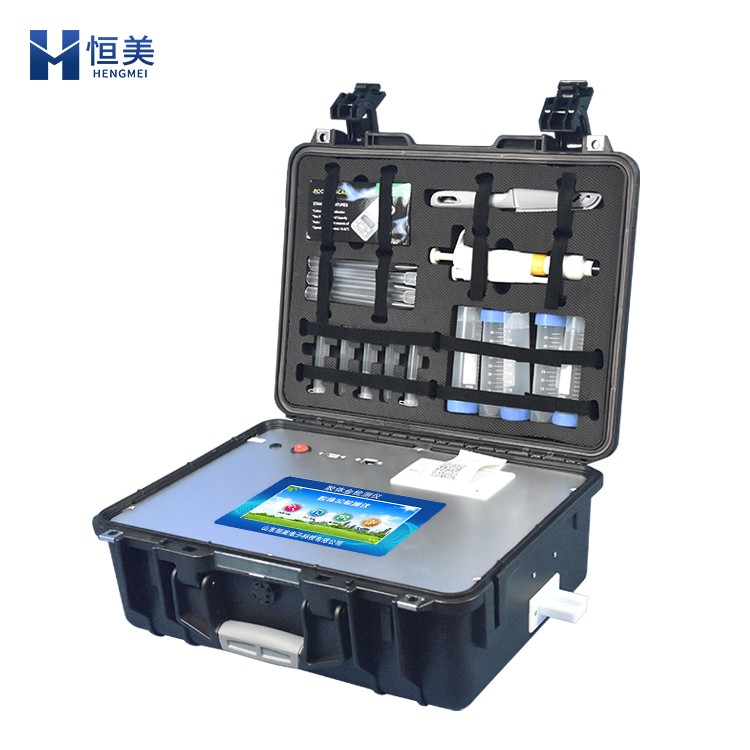
The HM-DWYB carrying-case arrangement shown above illustrates the equipment format. Supplied consumables and accessories depend on the selected configuration; test cards are not included in the standard HM-DWYB configuration.
HM-Y96A and HM-Y96B: compare ELISA plate requirements
HM-Y96A and HM-Y96B use absorbance measurements for compatible ELISA workflows. Both specify eight optical measurement channels and standard filters at 405, 450, 492 and 630 nm. Select the filter and calculation settings required by the kit, rather than treating any absorbance value as a disease diagnosis.
| Manufacturer-listed feature | HM-Y96A | HM-Y96B |
|---|---|---|
| Display | 18.5-inch touchscreen | 10.4-inch touchscreen |
| Absorbance range | 0.000–3.500 Abs | 0.000–4.000 A |
| Single-wavelength plate reading | 6 seconds | ≤3 seconds per 96-well plate |
| Dual-wavelength plate reading | 10 seconds | ≤6 seconds per 96-well plate |
| Standard filters | 405, 450, 492, 630 nm | 405, 450, 492, 630 nm |
These are instrument specifications, rather than a comparison of diagnostic sensitivity. A 96-well plate also needs space for the controls, standards and replicates required by the assay, so plate capacity should not be equated with 96 reportable animal samples. Include reagent preparation, incubation and washing in the workflow assessment; reading speed alone does not describe total turnaround time.
HM-P16: check the molecular workflow and channel match
HM-P16 combines thermal cycling with real-time fluorescence detection. The animal disease application specification lists 16 × 0.2 mL sample positions, reaction volumes of 15–100 µL and two fluorescence channels. Listed dye compatibility is FAM/SYBR Green for the first channel and HEX/JOE/VIC for the second. Its stated weight is 5.6 kg and power requirement is 220 V, 50 Hz, 255 W.
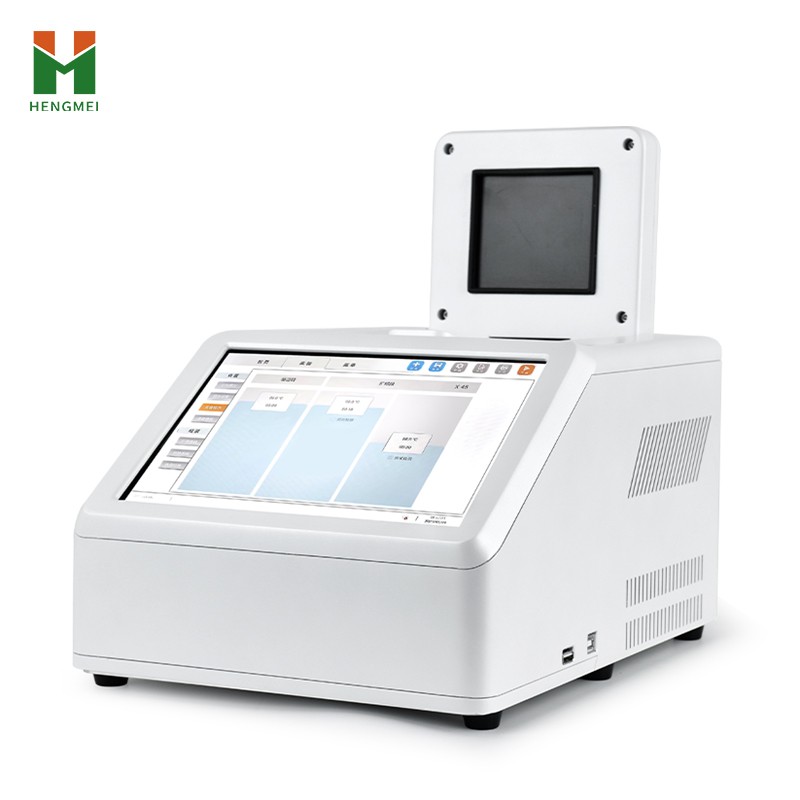
The real-time PCR instrument image illustrates the equipment category. Choose the ordered model and configuration from its specification. When planning a run, reserve positions for the assay's required controls and verify the reaction vessels, optical channels and analysis settings. Include sample preparation and nucleic acid extraction in the equipment plan. For RNA targets, select an assay workflow that includes the necessary reverse-transcription step.
A practical purchasing checklist
- Define the question: name the target, species, sample matrix and intended use of the result.
- Match the complete assay: specify the reagent kit, card or plate format, wavelengths or fluorescence dyes and calculation method.
- Plan the real workload: count controls and replicates, preparation time, incubation, washing or extraction, and reporting.
- Confirm the installation: check power, operating environment, workspace, data export and printing requirements.
- Compare the supplied configuration: list the reader, reagents, consumables, accessories and any separate preparation equipment.
Common questions
Is a colloidal gold reader a PCR instrument?
No. HM-JD01, HM-JD02 and HM-DWYB read signals on test cards. HM-P16 detects fluorescence during nucleic acid amplification. Their reagents, sample preparation and result interpretation are different.
Does a faster reading time mean faster diagnosis?
Reading time is only one stage. Compare the complete assay workflow, including sample preparation, reaction time and control acceptance, before estimating reporting time.
Can one reader test every animal disease?
The available menu depends on compatible, appropriately validated assays for the intended target and sample. A list of possible applications does not establish that every kit is included or that one result supports every diagnostic decision.
Find the right configuration
For a card-reading workflow, see the HM-DWYB animal disease detector. To compare the six models in this guide, provide the target, sample type, expected daily workload and preferred method through the website's contact channel. This information allows the instrument, reagents and preparation equipment to be considered together.
Article address:https://www.molecularbio.cn/news/animal-disease-diagnostic-instruments-selection-guide.html